

Benjamin Harrison by Evan Thomas
Charisma garners attention, but competence produces results

“Damn the President! He is a cold-blooded, narrow-minded, prejudiced, obstinate, timid, old psalm-singing Indianapolis politician,” Theodore Roosevelt once said of Benjamin Harrison. Our 23rd president, Harrison was bearded and short of stature, with beady, suspicious eyes and a slight slump. Widely seen as a cold fish, Harrison is generally remembered as a mediocrity—if he’s remembered at all. In 2012, New York magazine dubbed him “America’s Most Forgotten President.”
Being unmemorable was not unusual for presidents of the Gilded Age, as Mark Twain labeled the three-decade period between Reconstruction and the beginning of the Progressive era in the 20th century. Power lay with the newly rich who had amassed great fortunes from the Industrial Revolution. Politics was largely the province of city and state bosses who made deals that were often corrupt. Yet despite the grubbiness of American politics of the time, and Harrison’s relatively unremarkable presidency, his style of leadership suggests that while charisma garners attention, it is competence that produces results.
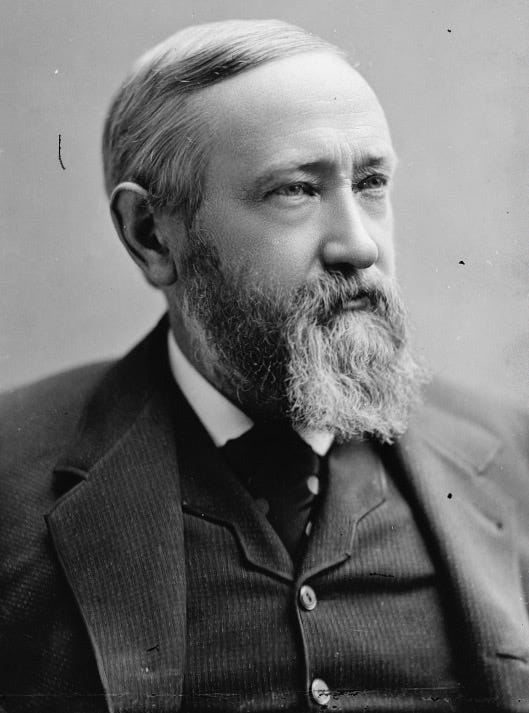
Raised in a pious Presbyterian household, Benjamin Harrison became a member of the newly-created Republican Party in the 1850s because he thought slavery was immoral, and the Republicans opposed its expansion. Harrison left his prosperous law practice in Indianapolis to raise a regiment of Hoosiers to fight in the Civil War. Leading from the front—shouting “Come on, boys!”—he exposed himself to enemy fire in several battles and returned home a hero. The grandson of a U.S. President, William Henry Harrison, and the great grandson of a Founding Father—his namesake, Benjamin Harrison, signed the Declaration of Independence on behalf of Virginia—he was a natural candidate for office in Indiana and served a term in the U.S. Senate. He was stand-offish, at least in public, but he was an energetic orator, and in the presidential election of 1888, he narrowly defeated the Democratic incumbent, Grover Cleveland, losing the popular vote but winning the Electoral College.
Harrison was known for scrupulous personal integrity. He thoroughly disapproved of the practice of awarding government jobs to friends, relatives, and supporters, the so-called “spoils system” that infected all levels of government from the nation’s capital down to city hall. Theodore Roosevelt may have chafed at Harrison’s caution and slightly holier-than-thou air, but it was President Harrison who gave Roosevelt his first chance at national prominence. He chose Roosevelt, at the time an excitable local politician in New York, to serve on the U.S. Civil Service Commission, which sought to strengthen the effort to replace patronage with merit appointments. Harrison himself, frustrated by the constant demands from job seekers who accosted him during his walks and meals, confessed after only five weeks at the White House, “I do sometimes feel like a hunted animal.” He was determined to put government on a higher plane, starting with Congress.
An activist who believed in strong government in the tradition of Alexander Hamilton, Harrison understood that government could not be passive in the face of economic change. He successfully pressed Congress to enact the Sherman Anti-Trust Act in 1890, though it would be more than a decade before federal prosecutors—under the fiery Teddy Roosevelt—were able to begin truly busting up the railroads and other trusts monopolizing key elements of the economy.
Likewise, Harrison successfully pressed for a system of tariffs that would help America negotiate trade deals with other nations, as well as fill the coffers of the U.S. Treasury. He directed these funds towards large projects of national renewal, setting aside national forests and building a strong Navy to project America’s emerging power around the world.
Harrison’s partner in statecraft was his secretary of state, James Blaine. Known as the “Plumed Knight,” Blaine was charismatic and sought the headlines. But he had a self-indulgent streak and preferred to leave the steamy nation’s capital to spend the summer—and some of the fall—at his country place in Bar Harbor, Maine. It was Harrison, always a hands-on administrator with a lawyerly attention to detail, who did most of the work. Prodded by Harrison, the 51st Congress passed 531 public laws, a record not equaled until Teddy Roosevelt’s second term three presidencies later.
Harrison’s greatest cause was voting rights in the South. The shameful Compromise of 1877 had handed the disputed 1876 election to Rutherford B. Hayes over his opponent Samuel Tilden, in exchange for removing the federal troops who had enforced civil rights in the post-Civil War South—effectively consigning formerly enslaved Blacks to peonage. After Reconstruction died, states in the Old Confederacy systematically denied the formerly enslaved the right to vote. Worse still, the pace of lynchings—“the shame of our Christian civilization,” mourned Harrison—picked up.
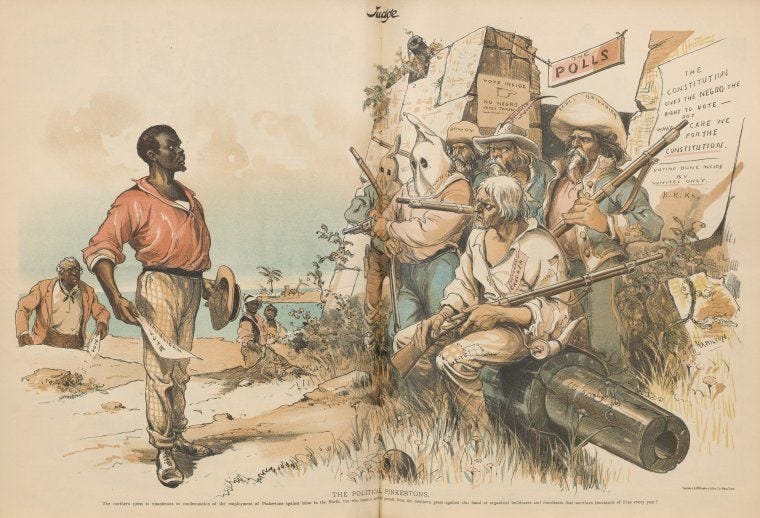
Harrison demanded that Congress pass a bill to protect voting rights for Blacks. It was immediately dubbed “the Force Bill” by Southern Democrats who scare-mongered with images of federal soldiers arriving in Dixie armed with bayonets. Harrison persisted, winning passage of the bill in the House of Representatives. “To my mind we never had a greater president,” said the famed Black leader Frederick Douglass, who had worked with Abraham Lincoln. (Harrison’s record towards Native Americans was less exemplary. He helped cover up the infamous 1890 Wounded Knee massacre of more than 250 Lakota Indians, many of them women and children, by awarding the soldiers involved nineteen Medals of Honor.)
But the country, and not just the South, was not ready for reform. Accustomed to a small, passive government that did not intrude in their lives, Americans in 1890 flocked to the Democrats, who regained control of Congress. The voting rights bill was dead and so were Harrison’s hopes of accomplishing much more in office.
After two and a half years, Harrison confessed to a friend that he was feeling “very much worn out,” from the “exacting and troublesome” nature of his job. Harrison was a lonely figure. In that more innocent age, the President could sometimes be found sitting alone at a corner drug store, sipping a soda. When his family was away at the shore for the summer, Harrison found the White House empty and forlorn. The 90-year-old building had been recently fitted with new-fangled electric lights, but Harrison and his wife Caroline were reluctant to turn them on or off for fear of electrocution. They sometimes left the lights glowing brightly through the night.
In 1892, the First Lady’s nagging cough turned into consumption—tuberculosis. With his devoted wife fatally ill, Harrison had little heart for a re-election campaign. He was briefly stirred to action when Blaine, his perfidious secretary of state, ran against him for the Republican nomination. Harrison overcame Blaine’s challenge, but his weakened campaign limped to the finish line. Two weeks before the election, Caroline Harrison died. “I was so removed from the campaign that I can scarcely realize that I was a candidate,” Harrison wrote a supporter. With darkening economic news, Grover Cleveland, the Democrat Harrison had narrowly defeated in 1888, swept back into office, the first president until Donald Trump to be elected to non-consecutive terms.
Harrison was never a happy warrior. “I have never enjoyed public life and do not seem to have the mental adaptation which could enable me to get satisfaction out of it,” he wrote a friend. “I always carry care and responsibility heavily.” But if he was not a glad-hander, neither was he a pushover. Some of his reputation for coldness, noted President Lincoln’s former secretary, John Hay, came because he was willing to say no. And if he was in some ways an old-fashioned figure, a fundamentalist Presbyterian made uncomfortable by Edison’s modern lighting systems, he was also a forward-looking statesman. He set the stage for the modern presidency of more charismatic figures like Teddy Roosevelt, while demonstrating that leaders need not be electrifying to be effective.
Evan Thomas was a writer, correspondent, and editor for thirty-three years at Time and Newsweek, including ten years (1986–96) as Washington bureau chief at Newsweek, where, at the time of his retirement in 2010, he was editor at large. He is the author of eleven books, including First: Sandra Day O’Connor (2020).
Listen to In Pursuit with Colleen Shogan on your favorite podcast app.
In Pursuit is a landmark initiative of More Perfect, a bipartisan alliance of 44 Presidential Centers, National Archives Foundation, American Academy of Arts and Sciences, Karsh Institute for Democracy at the University of Virginia, and more than 100 organizations working together to protect and renew our democracy as we approach the 250th anniversary of the Declaration of Independence and beyond.
An informative and interesting essay.
Excellent appreciation of an unappreciated and just forgotten president. Evan Thomas should wrote a biography of Harrison, a president with almost no modern bios.
I was very interested in this essay since my first job where I had a wear a tie was as a tour guide at the President Benjamin Harrison Presidential Site in Indianapolis many years ago and know more about Harrison than most people.